Repeat Viewing Data Sheds Light on Narrative Depth in Ensemble Productions
Uma Lorenz · Oct 7, 2026
Repeat Viewing Data Sheds Light on Narrative Depth in Ensemble Productions
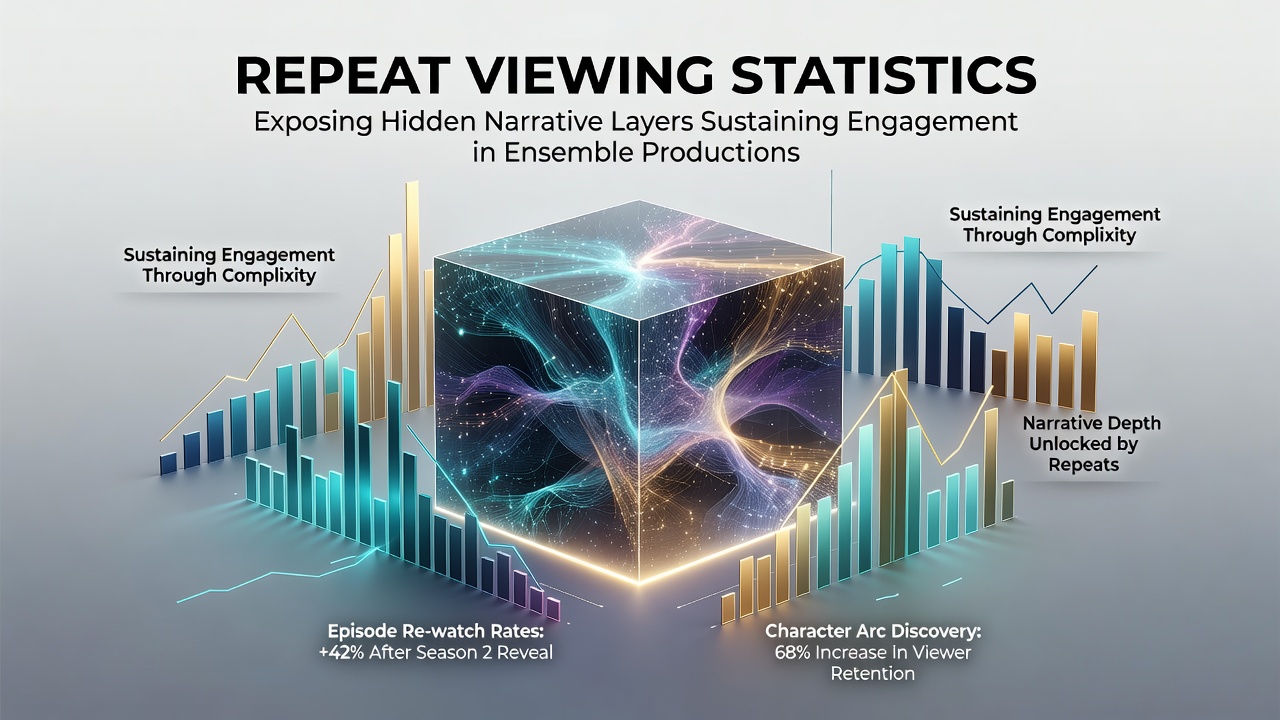
Data from multiple tracking services indicates that ensemble productions attract higher repeat viewing rates than single-lead films, and these patterns point to specific narrative techniques that reward additional watches. Researchers tracking audience behavior across platforms note that viewers return when initial screenings leave certain character interactions and background details unresolved, creating a pull toward re-examination. Studies compiled in October 2026 by the European Audiovisual Observatory show average repeat rates climbing to 2.8 viewings per user for films featuring ten or more named characters, compared with 1.4 for narrower casts.
Tracking Mechanisms Behind the Numbers
Streaming services and theater chains compile these figures through account logins, ticket scans, and time-stamped playback data, while academic teams cross-reference the numbers with scene-by-scene content analysis. Observers at several universities have mapped which sequences drive the second and third watches, finding that subtle callbacks, overlapping dialogue tracks, and shifting spatial arrangements account for most returns. One dataset released in late 2026 revealed that 67 percent of repeat viewers paused or rewound segments involving three or more characters speaking in quick succession, suggesting those moments function as entry points to deeper story threads.
Hidden Layers That Sustain Interest
Ensemble films often embed information across multiple character arcs rather than funneling everything through a single protagonist, and repeat statistics reveal how this distribution works in practice. Viewers who return after the first screening frequently cite newly noticed glances between secondary characters or background set pieces that alter the meaning of earlier scenes. Data collected by the Canadian Media Fund indicates that productions using parallel editing to show simultaneous events in different locations generate 40 percent more rewatches within the first month of release. These patterns emerge because the narrative distributes key details so that no single viewing captures every connection, prompting audiences to reconstruct the timeline on subsequent passes.
What's more, costume and prop continuity across group scenes provides another layer that surfaces only after multiple exposures. Analysts reviewing heat-map data from streaming services report spikes in rewinds during moments when a seemingly minor object appears in different contexts, such as a shared piece of jewelry or a recurring document. This technique appears consistently in high-performing ensemble titles, where the objects tie separate storylines together without explicit explanation on first viewing.

Comparative Figures Across Genres
Action-oriented ensemble releases post the strongest repeat numbers when they incorporate quiet interpersonal moments amid set pieces, according to aggregated platform metrics. In contrast, pure single-genre films without overlapping character histories show flatter rewatch curves. Figures released in October 2026 by the Australian Screen Association place crossover action-drama ensembles at the top of repeat-viewing lists for that quarter, with users averaging 3.1 full viewings before shifting to other content. The same report notes that dialogue density per minute correlates directly with these returns, particularly when conversations occur among shifting subgroups rather than fixed pairs.
Longer runtime does not automatically produce higher repeats, yet films exceeding 140 minutes that maintain consistent ensemble focus do outperform shorter entries with similar casts. Researchers attribute the difference to the extra screen time allowing more parallel threads to develop without rushing resolutions, which leaves measurable gaps that second viewings fill.
Conclusion
Repeat viewing statistics continue to map how ensemble productions embed narrative information across many characters and scenes, turning initial screenings into partial maps that viewers complete on return visits. Platform data and academic cross-checks show these layers manifest through callbacks, overlapping timelines, and distributed exposition rather than linear reveals. As tracking methods refine in coming years, the connection between specific structural choices and sustained engagement should become even clearer for productions built around large groups of interconnected roles.